

For about a week, I couldn’t sleep past 4am. Because I couldn’t stop thinking about what I can do with Claude Cowork for work and personal projects.
The more I experiment with it, the more I realize it can do. And the more excited I am.
And I am shook. Because for the past 3 years, I have not been an AI hype cheerleader. It’s a bit emotionally shocking to find myself on the agentic AI train so suddenly.

Three Years of Disappointing AI Tools
I professionally evaluate AI tools and techniques as a design researcher, largely publishing my findings and perspective on NN Group — a design research and consulting firm that’s been the industry’s go-to source for evidence-based design guidance for nearly 30 years.
Since 2023, our team has been putting AI claims to the test, particularly in the context of UX and product design... and we’ve been consistently very disappointed. GenAI tools developed impressively over the past three years, but their useful applications fell short of the AI-powered utopia promised by AI fanboys. The most useful, reliable applications of genAI have been the least sexy — information retrieval, summarization, communication.
(And to be clear, I think one of the problems of AI hype has been to minimize the massive contributions of those “boring” use cases that are actually revolutionary. If LLM technology didn’t advance past 2025, it could still make meaningful improvements to our work. It’s just that those uses aren’t the same as the “AI-will-do-your-job” message we’ve been drowning in.)
Here’s a sample of the receipts:
We tested AI-powered UX research tools and found most couldn’t deliver on their marketing promises.
We tested synthetic users — AI-generated fake research participants — and had to update our own slogan: UX without real-user research isn’t UX.
I wrote about why AI features need to solve actual user problems instead of chasing novelty, and gave conference talks showing research on how people don’t adopt AI features when teams skip basic design work.
Earlier this year, I published pieces on demanding accuracy from AI tools and on the state of our field after two years of hype and layoffs.
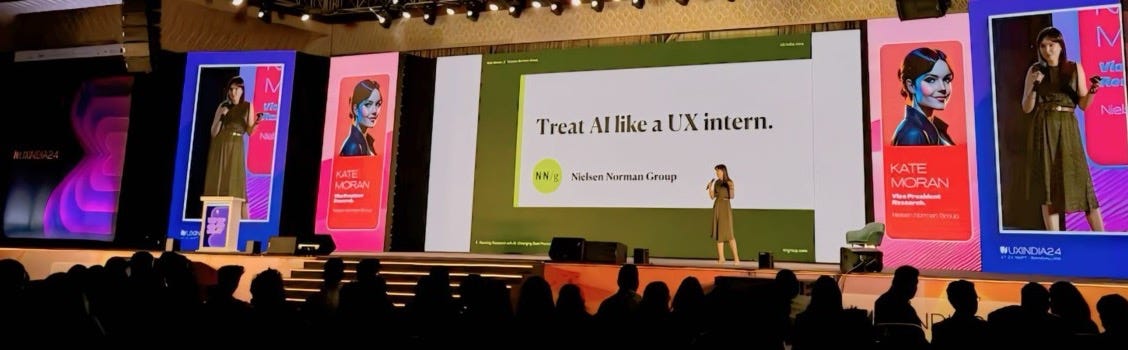
I was a skeptic. An informed, evidence-based, show-me-the-receipts skeptic. And I was consistently right to be. And I still consider myself, largely, to be a skeptic of most of the AI tools that people are trying to sell me. I’ve been waiting for the agentic future that we’ve all been promised, but I’ve seen little evidence so far.
Then I started using Claude Cowork with a structured external memory system — a set of markdown files that give the AI persistent, on-demand context about my work, my team, my preferences, my projects, my editorial standards — and something fundamentally shifted.
It Wasn’t Just the Model
The difference wasn’t the AI getting smarter (though that has certainly helped.) The big difference was the scaffolding.
Claude Cowork (currently) works by pointing to a sandbox folder on your computer. Within that folder, it can make changes to files through code. (It can’t navigate your desktop or use your apps for you, other than a janky “debug” tab in Chrome, which does open a lot of possibilities but is infuriatingly slow.)
Once the AI had structured context about who I am, what I’m working on, and how I think about my work, the quality of everything it produced jumped. Prompting got easier because I didn’t have to re-explain myself every session. The outputs got better because they were grounded in real context instead of what I could prompt-engineer in a few minutes.
Tasks I’d been doing manually for years — weekly briefings, CEO status updates, meeting prep, editorial tracking — suddenly had a capable first pass that I could react to instead of building from scratch.
But the memory files are only half the picture. Anthropic has been rolling out connectors — integrations with tools like Slack, Notion, Google Calendar, and meeting-transcription apps — that give Cowork real-time context alongside the persistent stuff. So when I ask it to prep me for a meeting, it’s pulling from both: the memory files that know my team’s names, roles, and current projects, and the live data from my calendar, recent Slack threads, and last week’s meeting notes.
To make this more concrete, here’s a simplified version of the folder structure I’ve built:
working-folder/
├── memory/
│   ├── people/          # Org chart, key relationships, team members
│   ├── projects/        # Active workstreams, status, decisions
│   ├── business/        # Company strategy, audience, industry context
│   └── preferences/     # Scheduling patterns, editorial standards
├── workflows/
│   ├── weekly-plan      # Monday briefing routine
│   ├── status-update    # CEO update process
│   └── meeting-prep     # Pre-meeting context loading
├── skills/              # Reusable task instructions (writing, editing, etc.)
└── reference/           # Style guides, idea banks, article archives
Every file is plain markdown. Nothing fancy. The AI reads what it needs at the start of a task, and I tell it to update files when something changes. It’s manual, it’s imperfect, and it works far better than I could have predicted.
It’s not about how smart the AI is. It’s about how its thinking is structured.
That realization has massive implications. The people waiting for GPT-6 or Claude 5 to “finally be useful” might be waiting for the wrong thing. The unlock isn’t a better model — it’s a better architecture around the model. The gap between people who figure out how to scaffold AI effectively and people who keep prompting from a blank text box is going to get very wide, very fast.
What’s Still Broken
Cowork is by no means perfect. I would say it isn’t close to ready for widespread consumer adoption at the time of writing. It (like pretty much every AI product these days) is in beta.
It’s basically a veneer of abstracted UI sitting on top of Claude Code right now.
The memory system itself is duct tape. Markdown files in a folder. I manually decide what goes where, what gets updated, what context to load for which task.
I actually had Claude pull down emerging “best practices” for memory architecture from Reddit, turn that into a Claude “skill,” and periodically tell Cowork to go clean up its file structures.
There’s no automated sync, no way for the system to know what it doesn’t know. When it works, it works because I’ve built the architecture carefully and update it constantly. This is scaffolding in the most literal sense — temporary, built by hand, holding something up that doesn’t yet stand on its own.
I have no doubt that Anthropic is aware of these issues and working on solutions. I expect that these “memory architecture” skills will soon go the way of “prompt engineer” job posts — they’ll be quickly made irrelevant as the technology improves.
Cowork Is Messing with My Brain
I have OCD (clinically). My brain locks onto thoughts and won’t let go. Over the course of my life, I’ve channeled my obsessions into productivity, because that’s what gets rewarded. Society doesn’t pathologize the person who can’t stop working. It promotes them.
So when I encountered a tool that suddenly made my work dramatically more efficient and opened up dozens of new possibilities simultaneously, my brain did what it does: it latched on. Hard. Every waking moment became an optimization opportunity. Every process became a candidate for automation. Every team member became someone I needed to onboard onto this new way of working, immediately. Walking away from my computer was painful.
I spiraled. Too many ideas, too much urgency, not enough sleep. The classic pattern, just with a new trigger.
I’m probably not the only one who will have this kind of reaction.
My specific flavor of neurodivergence made me extra susceptible, but I don’t think you have to have a clinical diagnosis to have this kind of response.
If you’re the kind of person who gets deep into systems and tools and optimization — and that describes a significant chunk of the tech community — the moment agentic AI actually works for you is going to be a lot. It’s worth being ready for that.
The Questions I’m Mulling Over
I lead research and content at NN Group. Our audience is UX designers, researchers, product people — practitioners trying to figure out what AI means for their work and their careers. I’ve been cautious in my recommendations because we know our audience relies on us for advice that actually works. If I haven’t seen an AI tool deliver real quality, then I won’t recommend it.
But now I’m sitting with a system that genuinely handles a significant portion of my administrative and analytical work, and I have to reckon with what that means. Not in the abstract “AI will change everything” sense — in the specific, concrete, “here’s what my Tuesday looks like now versus six months ago” sense.
I don’t have a tidy conclusion. I’m still in the middle of it. The mania is settling into something more sustainable, but the questions aren’t going away:
What should organizations actually be investing in? If the unlock is architecture, not model capability, how can we be preparing our data and systems with a strong focus on context?
What happens to junior roles when senior people can suddenly handle 3x the administrative overhead that used to get delegated down?
What needs to change in agentic AI design to allow more people to tap into these capabilities?
What are the consequences of sharing this much context with these companies? On a both personal and professional level, the security and privacy risks are real.
I have some thoughts on these — and I’ll be writing about them in upcoming posts. But I wanted to start here, with the honest version: I spent three years being a skeptic, and then a tool broke through my defenses in about a week. That’s worth examining, not just celebrating.
If you’re experimenting with agentic AI and finding it either overhyped or life-changing, I’d like to hear about it. I’m trying to figure this out in public, which is uncomfortable, but I think it’s more useful than waiting until I have a neat framework to present.
More soon. Here and at nngroup.com.
I work as a UR on developer tooling at Spotify and it has made me extraordinarily aware of how far ahead concrete implementation of AI is in that space. If you haven’t already, I highly recommend you look into how the most mature engineering organizations are building context infrastructure to utilize AI because there is a LOT of very exciting learnings that I believe can be applied to how research and insights can drive impact in a company (and yes it makes me kind of manic just like you mentioned)
Same boat here! But while it does do a lot of the work for you, do you find you truly understand it? I work through my understanding by doing the work so much that if I just get the finished product I glaze over it don’t develop deep understand.